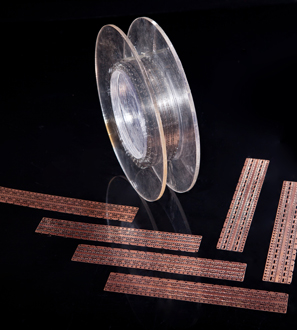
Controlled Expansion Alloys for Glass and Ceramic Sealing
Controlled expansion alloys are precision alloys selected for their thermal expansion behavior over a defined temperature range. They are used when a metal component must be joined to glass or ceramic and the expansion behavior of both materials needs to be considered.
Beiye manufactures Fe-Ni and Fe-Ni-Co controlled expansion alloys under BYP and 4J designations. Start your grade selection with the material being sealed, then compare the application and technical data listed for each alloy. If you are evaluating a different type of thermal expansion alloy, see Beiye's expansion alloy.
Types of Controlled-Expansion Alloy
BYP27 (4J42k) Controlled-Expansion Alloy
BYP24 (4J42) Controlled-Expansion Alloy
BYP30 (4J45) Controlled-Expansion Alloy
BYP44 (4J50) Controlled-Expansion Alloy
BYP45 (4J52) Controlled-Expansion Alloy
BYP45 (4J52) Controlled-Expansion Alloy
BYP46 (4J54) Controlled-Expansion Alloy
4J6 Controlled-Expansion Alloy
BYP2 (4J6a) Controlled-Expansion Alloy
BYP42 Controlled-Expansion Alloy
BYP43 Controlled-Expansion Alloy
BYP31 (4J47) Controlled-Expansion Alloy
BYP41 (4J49) Controlled-Expansion Alloy
BYP40 (4J48) Controlled-Expansion Alloy
BYP12 (4J29) Controlled-Expansion Alloy
4J44 Controlled-Expansion Alloy
BYP17 (4J33) Controlled-Expansion Alloy
BYP18 (4J34) Controlled-Expansion Alloy
BYP11 (4J28) Controlled-Expansion Alloy
BYP29 (4J43) Controlled-Expansion Alloy
Characteristics of Controlled Expansion Alloys
As a specialized precision alloy manufacturing company, Beiye offers engineered materials designed to exhibit minimal thermal expansion across a wide temperature range. The unique properties of controlled expansion alloys make them essential in precision applications. Key characteristics include:
Low Thermal Expansion: Controlled expansion alloys, such as Invar (Fe-36Ni), have a coefficient of thermal expansion (CTE) close to zero, ensuring dimensional stability under temperature fluctuations.
High Dimensional Stability: Controlled expansion alloys maintain consistent size and shape, critical for applications requiring precision, like optical systems or aerospace components.
Tailorable CTE: By adjusting alloy composition (e.g., nickel content in Fe-Ni alloys), the CTE can be customized to match specific materials like glass or ceramics.
Good Mechanical Strength: Controlled expansion alloys offer sufficient strength and toughness for structural applications, despite their focus on thermal stability.
Corrosion Resistance: Many alloys, such as Kovar, exhibit resistance to oxidation and environmental degradation, enhancing durability.
Magnetic Properties: Some alloys, like Invar, are ferromagnetic, which can be advantageous or limiting depending on the application.
Machinability: Controlled expansion alloys can be machined into complex shapes, though some alloys require specialized techniques due to their hardness.
These characteristics make controlled expansion alloys indispensable in industries requiring precision and reliability under thermal stress.
Controlled Expansion Alloy Grades by Sealing Application
The material being joined helps narrow the grades to review. Beiye lists the following applications on its product pages:
|
Sealing Application |
Beiye Grade |
Product Information |
|
Sealing with 95% alumina ceramics, including vacuum tube components |
BYP17 (4J33) |
Composition, expansion ranges and mechanical properties |
|
Sealing with 95% alumina ceramics |
BYP18 (4J34) |
Composition, expansion ranges and mechanical properties |
|
Hard-glass sealing |
BYP12 (4J29) |
Composition, expansion ranges and listed applications |
|
Glass-sealing components |
BYP24 (4J42) |
Composition, expansion ranges and listed applications |
This table is a shortlist for technical review. It does not mean the grades can be substituted for one another. For example, both 4J33 and 4J34 are listed for 95% alumina sealing, but their published compositions and expansion values differ.
Applications of Controlled Expansion Alloys
Aerospace Components: Alloys like Invar and Kovar are used in satellite structures, sensors, and optical mounts to maintain stability in extreme temperature environments.
Electronics and Semiconductors: Kovar is employed in hermetic seals, lead frames, and glass-to-metal seals for integrated circuits, ensuring compatibility with glass or ceramic components.
Precision Instruments: These alloys are critical in scientific instruments like telescopes, laser systems, and metrology equipment, where minimal thermal expansion ensures accuracy.
Medical Devices: Used in imaging equipment and diagnostic tools, where dimensional stability is vital for consistent performance.
Telecommunications: Controlled expansion alloys are found in optical fiber systems and microwave components, matching the CTE of glass fibers to prevent signal loss.
Energy Sector: Applied in LNG (liquefied natural gas) storage and transfer systems, where low thermal expansion prevents structural failure at cryogenic temperatures.
Automotive Industry: Used in sensors and precision components in engines, where thermal stability enhances reliability.
Other precision alloys you may like:
inco713
controlled expansion alloys
nife47
1j85
Don't miss these insights into:
elastic alloy
soft magnetic alloys
superalloy
ballistic corrosion resistant alloys